


Why Leasing the Right Commercial Space is Critical for Your Business
When you rent commercial space, you’re making one of the most significant decisions for your business’s future. Finding the right space requires strategic planning, as the commercial real estate market is complex and constantly changing.
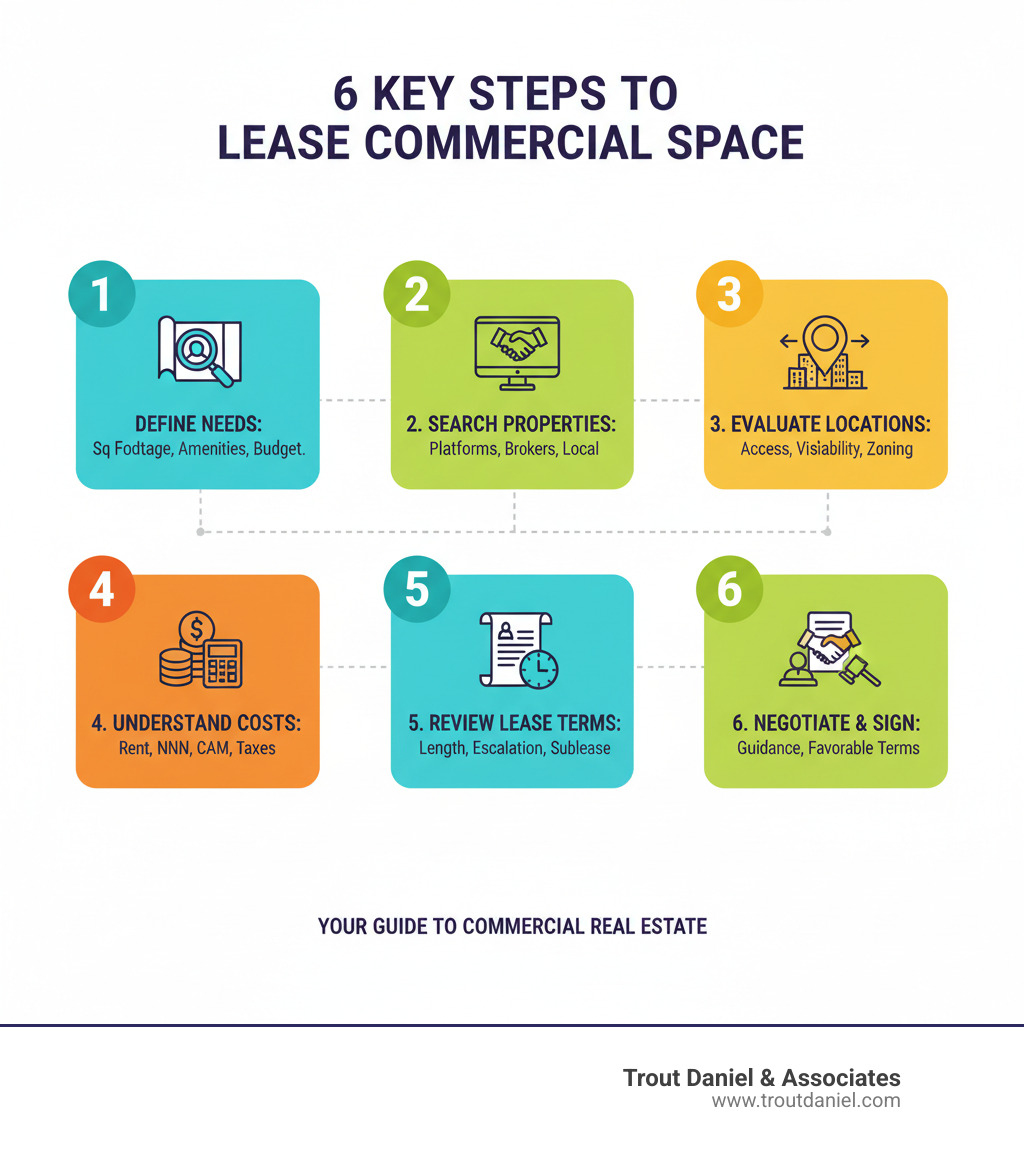
Quick Answer: How to Rent Commercial Space
- Define your needs – Calculate required square footage, amenities, and budget.
- Search for properties – Use listing platforms, brokers, and local connections.
- Evaluate locations – Consider accessibility, visibility, and proximity to customers.
- Understand costs – Review base rent, NNN charges, CAM fees, and other expenses.
- Review lease terms – Examine lease length, escalation clauses, and exit options.
- Negotiate and sign – Work with professionals to secure favorable terms.
Beyond finding available square footage, you need to understand lease structures. Will you sign a triple net (NNN) lease where you pay property taxes, insurance, and maintenance? What about Common Area Maintenance (CAM) charges? These costs can significantly impact your bottom line. Management fees typically range from 3.0% to 4.5% of rental income, with leasing fees often equivalent to one month’s rent or 4-6% of the total lease value.
The right commercial space is about positioning your business for growth, managing costs, and securing protective terms. Location matters enormously, and different areas offer different opportunities.
I’m Arthur Putzel, managing partner at Trout Daniel & Associates. Since 1987, I’ve helped businesses rent commercial space across multiple jurisdictions. My background includes serving as Deputy Director of the Baltimore County Economic Development Commission, giving me unique insight into how location and lease terms impact business success.
This guide walks you through the entire process, from understanding property types to negotiating favorable lease terms. We’ll cover market trends, hidden costs, and the strategic advantages of working with experienced representation.
Understanding Commercial Property: Types and Key Decisions
Before you rent commercial space, you need to understand the available property types and decide if leasing or buying is right for your business. Making an informed choice aligns with your long-term goals.
The Different Types of Commercial Spaces
Commercial property includes a wide range of buildings, each serving different business needs.
Office space ranges from small suites to large corporate campuses, often marketed as Class A (premium), B (average), or C (basic). Our Office team can help you consider these options.
Retail space is for customer-facing businesses where visibility, foot traffic, and accessibility are paramount. You can explore retail availability in Baltimore County and the surrounding markets. Our Retail specialists are serving clients as nearby as Timonium, and as far as Ocean City, Maryland; they have a wealth of market knowledge in Baltimore County and the surrounding areas.
Industrial properties are for manufacturing, warehousing, and distribution, featuring high ceilings, loading docks, and large bay doors. Our Industrial team has deep experience in this sector.
Flex space is a hybrid, combining office areas with warehouse or light industrial space. It’s ideal for businesses needing both administrative and operational facilities.
Multi-family buildings often feature ground-floor commercial units, providing a built-in customer base for retail or service businesses. Learn more from our Multi-Family experts.
Special purpose properties are designed for a single use, such as restaurants, car washes, or hotels, and often have custom build-outs.
Medical office buildings (MOBs) are a stable real estate segment catering to healthcare providers. According to GlobeSt, MOBs have reached record-low vacancy rates. Another GlobeSt. study notes that their longer lease terms provide stability, making them attractive in uncertain markets.
Leasing vs. Buying: Which is Right for Your Business?
Deciding whether to rent commercial space or buy it is a fundamental financial choice. We help clients evaluate this decision in our article My Company Needs to Move: Should I Buy or Lease?.
Leasing requires less upfront capital, offers flexibility to relocate, and makes rent payments a tax-deductible operating expense. The landlord typically handles major maintenance. However, you don’t build equity and have limited control over property modifications.
Buying requires significant capital but provides full control, potential property appreciation, and tax benefits like mortgage interest and depreciation deductions. It’s best for established businesses with stable needs, but offers less flexibility if you need to move.
| Feature | Leasing Commercial Space | Buying Commercial Property |
|---|---|---|
| Capital Expenditure | Lower upfront costs (security deposit, first month’s rent). | Significant upfront capital for down payment, closing costs, etc. |
| Flexibility | Easier to relocate or expand as business needs change; shorter commitments. | Less flexible; selling can be time-consuming and market-dependent. |
| Maintenance | Landlord typically responsible for major repairs and maintenance (depending on lease type). | Owner is responsible for all repairs, maintenance, and capital improvements. |
| Tax Implications | Rent payments are generally tax-deductible as operating expenses. | Potential for depreciation deductions, mortgage interest deductions, and property tax deductions. |
| Asset Appreciation | No direct equity or appreciation benefits. | Potential for property value appreciation over time. |
| Control | Limited control over property modifications and usage. | Full control over property modifications and usage. |
| Responsibility | Fewer responsibilities related to property ownership. | Full responsibility for property management and legal compliance. |
For many businesses, especially those that are growing or in dynamic industries, leasing is the more practical choice. It preserves capital and provides agility.
The Strategic Process to Rent Commercial Space
Once you decide to lease, a strategic search is your next step. This involves defining your needs, evaluating properties, and understanding local market nuances. A detailed plan makes the journey smoother.

Step 1: Defining Your Business’s Needs
Before looking at properties, get a clear picture of your requirements to avoid choosing the wrong space.
- Square Footage: Calculate space for employees, meetings, storage, and common areas. Plan for future expansion so you don’t outgrow your lease.
- Required Amenities: List your “must-haves,” such as high-speed internet, ample parking, loading docks, or accessibility features. This will guide your property tours.
- Zoning Requirements: Always verify that a property’s zoning allows for your specific business operations. This is a common and costly roadblock.
- Budget: Define a realistic budget that includes base rent plus all associated costs like utilities, maintenance, and insurance.
- Future Growth: Consider your 3 to 5-year plan. A lease with expansion options or a shorter term might be better if you anticipate rapid growth.
Step 2: Finding and Evaluating Potential Properties
With your needs defined, you can start your search using several methods.
Online listing platforms offer extensive databases to filter options by type, size, and location. You can get a sense of what’s available by searching for commercial real estate in markets where we operate, such as Baltimore, MD, Upper Marlboro, MD, Towson, MD, and Pikesville, MD.
Don’t overlook for-lease signs and networking. Driving through target neighborhoods can uncover properties not listed online, and talking to other business owners can reveal off-market opportunities.
Location is one of the most critical factors. Our article Choosing an Ideal Location for Your Business dives deeper, but here are the essentials:
- Accessibility: How easily can employees, clients, and suppliers reach you? Consider roads, public transit, and parking.
- Visibility: For retail and service businesses, high visibility acts as free marketing and drives foot traffic.
- Foot Traffic: Observe potential locations at different times to gauge customer flow, which is vital for retail and restaurants.
- Proximity to Customers and Talent: Is your location convenient for your target customers and a desirable area for recruiting employees?
- Zoning Regulations: Verify again that the zoning matches your business type before proceeding.
When you rent commercial space, you’re choosing a strategic location that impacts your entire operation. Evaluate thoroughly and trust your instincts alongside the data.
Decoding the Dollars and Documents of a Commercial Lease
Understanding the full financial and legal details of a lease is essential. Many tenants focus only on the base rent and get caught by unanticipated costs and clauses.

What are the typical costs when you rent commercial space?
The advertised rent is just the start. Your total occupancy cost includes several components.
- Base Rent: The fundamental cost for the space, usually quoted per square foot per year. Our article on Determining Fair Market Rent for a Property can help you gauge if an offer is fair.
- Triple Net (NNN) Leases: A common structure where you pay base rent plus your share of property taxes, building insurance, and common area maintenance. Understanding Shifting Risk on Leases from Triple Net Leases is critical.
- Common Area Maintenance (CAM) Charges: These fees cover shared spaces like parking lots, lobbies, and landscaping. They can vary significantly and hide unexpected costs.
- Utilities: Clarify upfront whether you pay for electricity, water, internet, and other services directly or if they are included.
- Tenant Improvement (TI) Allowance: This is money from the landlord to help you customize the space. It’s often negotiable and can offset significant upfront costs.
Your actual monthly payment will likely be higher than the base rent. Always ask for a detailed breakdown of all costs.
Key Terms and Clauses to Understand in Your Lease
Commercial leases are complex legal documents. The details matter immensely, as we cover in articles like What to Look Out For in Commercial Leases and our series on Lease Issues to Beware Of.
- Lease Term: The length of your commitment (e.g., 3, 5, or 10 years). Pay attention to renewal options, which give you the right to extend your lease.
- Rent Escalation Clause: This defines how and when your rent will increase, either by a fixed percentage or tied to an index like the CPI.
- Sublease Clause: Determines your right to lease out part or all of your space if your needs change. Negotiate for this flexibility upfront.
- Use Clause: Defines what business activities are permitted. Ensure it’s broad enough for your current and future plans.
- Exclusivity Clause: For retail tenants, this prevents the landlord from leasing to direct competitors in the same property.
- Maintenance and Repairs: Clearly defines who is responsible for what, from the HVAC system to the roof. These costs can be significant.
I explore this topic in more depth in my interview about Lease Pitfalls for Tenants. Always have a qualified commercial real estate attorney review your lease before signing. It’s an essential investment that can save you from costly mistakes.
Market Dynamics and Future-Proofing Your Lease
The commercial real estate market is constantly evolving. Understanding current and emerging trends helps you make smarter leasing decisions that position your business for future success.
How Market Trends Affect Your Ability to Rent Commercial Space
The space you lease exists in a broader economic context.
- Interest Rates: Rising rates can increase a landlord’s costs, which may be passed on in rent. Falling rates can create more room for negotiation.
- Local Economy: A thriving local economy means higher demand and less negotiating power for tenants. A slowdown can lead to more vacancies and better deals.
- New Construction: An increase in supply from new buildings can give tenants more choices and better terms.
- Local Market Trends: Every market has a unique personality. Understanding the pressures landlords face gives you leverage. As we discuss in What Landlords Need to Know About Lease Negotiations, knowing if a property has been vacant for a while can be a powerful negotiating tool.
Emerging Trends in Commercial Real Estate
The way businesses use space is changing, and the industry is adapting.
- Flexible Lease Terms: Shorter terms, expansion rights, and early termination clauses are becoming more common, offering businesses agility.
- Coworking Spaces: These offer scalable solutions for satellite teams, project work, or market testing without a long-term commitment.
- Sustainability and LEED Certification: Green buildings often mean lower utility costs, better air quality, and an attractive feature for recruiting talent.
- Technology Integration: Smart building features like automated HVAC, keyless entry, and mobile apps for booking amenities are becoming standard expectations.
- Mixed-Use Developments: These properties offer built-in foot traffic and convenience for employees and customers, which can justify premium rents for the right business.
Staying aware of these dynamics helps you sign a lease that serves your business for its entire term.
The Advantage of Professional Representation
When you’re ready to rent commercial space, navigating property options, complex leases, and negotiations can be overwhelming. A skilled commercial real estate broker turns this challenge into a strategic advantage.

Why Use a Commercial Real Estate Broker?
At Trout Daniel & Associates, we act as your guide, providing critical support that makes a tangible difference.
- Access to Listings: We provide access to comprehensive listings, including “off-market” properties that you would never find on your own.
- Negotiation Expertise: Our experience helps secure favorable terms, from lower rent to generous tenant improvement allowances, saving your business money.
- Transaction Management: We handle the complex process from property tours to closing, freeing you to focus on your business.
- Objective Advice: Our fiduciary duty is to you. We provide unbiased advice grounded in market reality to ensure you choose the right space. You can Meet Our Team of experienced professionals who will represent your interests.
How a Broker Helps You Prepare for a Lease
A broker’s value begins long before you sign a lease. We help you prepare to be an attractive, qualified tenant.
- Financial Preparation: We guide you in organizing your financial statements and business documents to present a strong case to landlords.
- Business Plan Review: We help you refine your business plan to highlight your stability and growth potential.
- Professional Connections: We connect you with our network of trusted professionals, including real estate attorneys and financial advisors.
- Offer Process Navigation: We help craft a competitive Letter of Intent that protects your interests while being attractive to the landlord.
Our comprehensive Services are designed to support you through every stage. We help you make a strategic real estate decision that benefits your business for years to come.
Conclusion
The decision to rent commercial space is a strategic choice that shapes your business’s future. We’ve covered the essentials: understanding property types, defining your needs, and decoding the financial and legal complexities of a commercial lease.
The real estate landscape is always changing, influenced by economic shifts and emerging trends. Navigating this complexity requires informed guidance.
At Trout Daniel & Associates, we provide industry-leading boutique service with a single point of contact dedicated to your goals. We’ve spent decades helping businesses find spaces that position them for long-term success, whether the client is seeking office, retail, or industrial properties.
Your commercial space should be a strategic asset. The right location and favorable lease terms can provide a competitive advantage. We understand local market dynamics and have the expertise to negotiate terms that protect your interests.
Ready to find the commercial space that will fuel your growth? Contact us to learn more about our multi-family property services or explore our full range of Services. You can also Meet Our Team to find the professional who will guide you through the process.
Let’s find your next space together.