

Understanding the Terminology
You don’t need to be confused by the language written in your Lease. Below is a simple explanation of the common terms you will encounter.
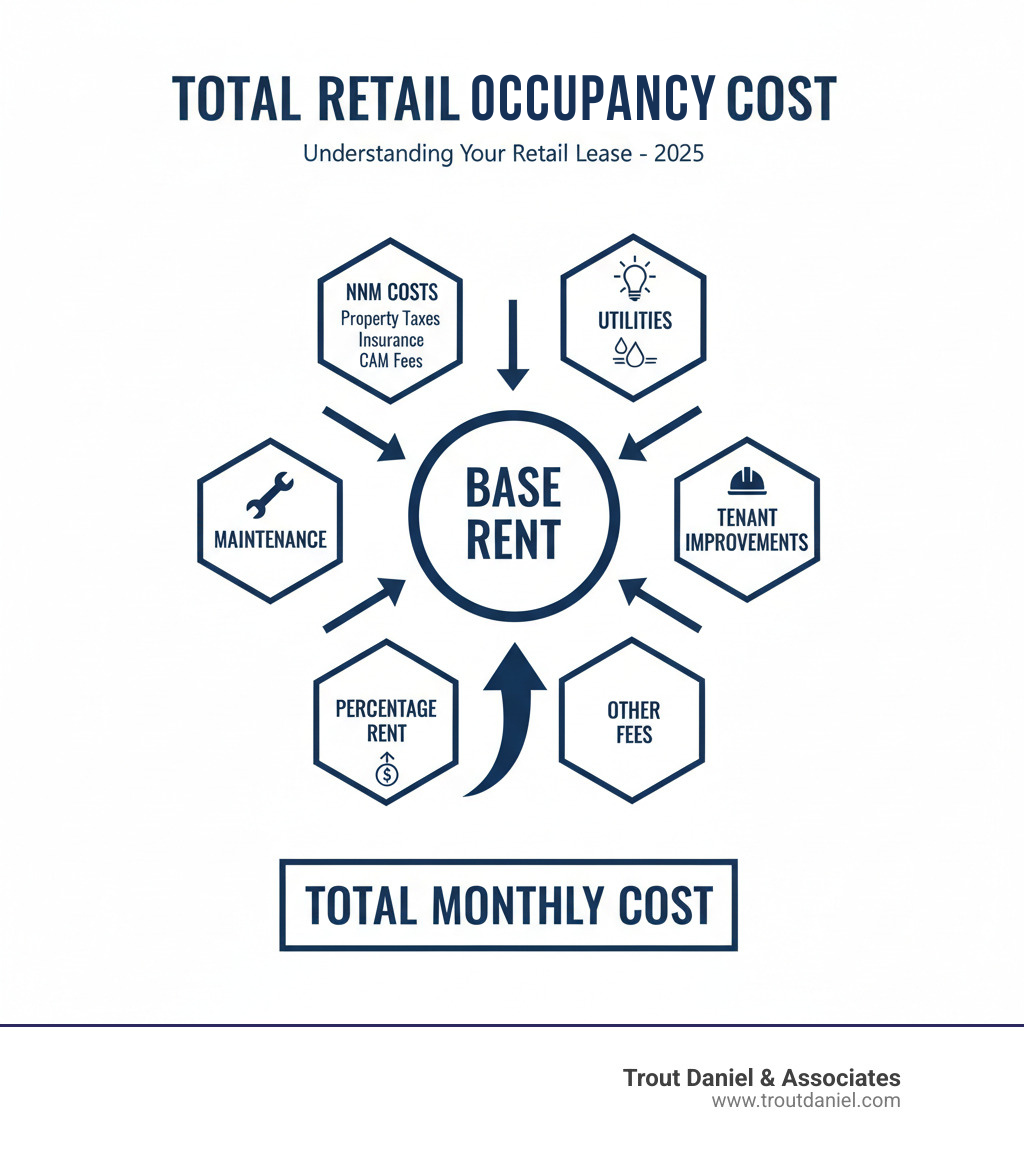
- Base Rent: Also called Minimum Rent, this is the Rent that the Landlord charges Tenants, BEFORE OPERATING EXPENSES are added.
- Operating Expenses: Also referred to as Triple Net (nnn) charges, these additional charges include Common Area Maintenance, Real Estate Taxes, and Insurance. these costs are paid directly by the Tenant to the Landlord, monthly.
- Annual Rent: Generally, the Rent will be quoted to the Tenant as a dollar amount per square foot (psf) with another figure for nnn charges psf. For example, a rent quote could be delivered as $20,00 per square foot with nnn charges of $4.50 psf. Simply add the two figures to determine the Total Rent psf: $24.50. It is very important to determine that the rent quote is being delivered as an annual rate not a monthly rate.
- Square Footage: This is the size of the Premises to be Leased by the Tenant. For example, the Premises to be leased is 1,500 sf.
- Monthly Rent: To determine the monthly rent due to the Landlord we use the numbers from our examples above: Total Rent ($24.50) x Square Footage (1,500 sf) = $36,750/12 months = $3,062.50 per month.
- Escalations: Often, Landlords will raise the Rent annually, per the Lease. It is typical to find Rent Escalations of three percent per year.
Trout Daniel and Associates can help you understand and negotiate the complexities of the Rent. It is important to understand these numbers, as well as to have a firm grasp of the market rents asked and negotiated in the trade area
As a licensed salesperson with Trout Daniel & Associates, it is my responsibility to thoroughly explain the costs associated with the Rent Payable by the Tenant. I’ve been negotiating Leases for restaurant retail, and service clients for over twenty years in the Mid-Atlantic states. I look forward to helping you to find space for your business and to negotiate your Lease. You can contact me, Scott Garfield, at sgarfield@troutdaniel.com, and (410) 960-4448
This guide breaks down everything you need to know about retail rental costs, from decoding lease terminology to budgeting effectively for your space. For custom guidance on controlling occupancy costs and structuring the right lease, explore our Retail Services.
Understanding Percentage Rent
Percentage Rent adds another complexity to understanding the costs of renting real estate. However, it can be explained simply. A Landlord may quote the rent as “$20.00 psf with $4.50 psf in nnns plus 8% over a natural breakpoint.
At 1,500 sf, the annual minimum rent is $30,000. Determining percentage rent we do not include operating expenses!
The “natural breakpoint” is determined by taking the annual minimum rent and dividing it by the agreed upon percentage rent: $30,000/.08 = $375,000. Any sales over the $375,000 in that particular Lease Year will be subject to percentage rent by taking the Total Sales, deducting the natural breakpoint of $375,000 and calculating 8% of that figure to determine the percentage rent due, on top of the Annual Rent. So, as an example, if the Tenant has sales of $500,000:
$500,000 – $375,000 = the overage is $125,000
$125,000 x .08 = $10,000
How the overage is paid will be determined by the Lease. Usually it is paid quarterly, the following Lease Year, or perhaps even monthly.
It is important to understand, though, with annual escalations in rent the Minimum Annual Rent increases in the equation. therefore, every Lease Year the Annual Rent factor changes.
Understanding the Operating Expenses
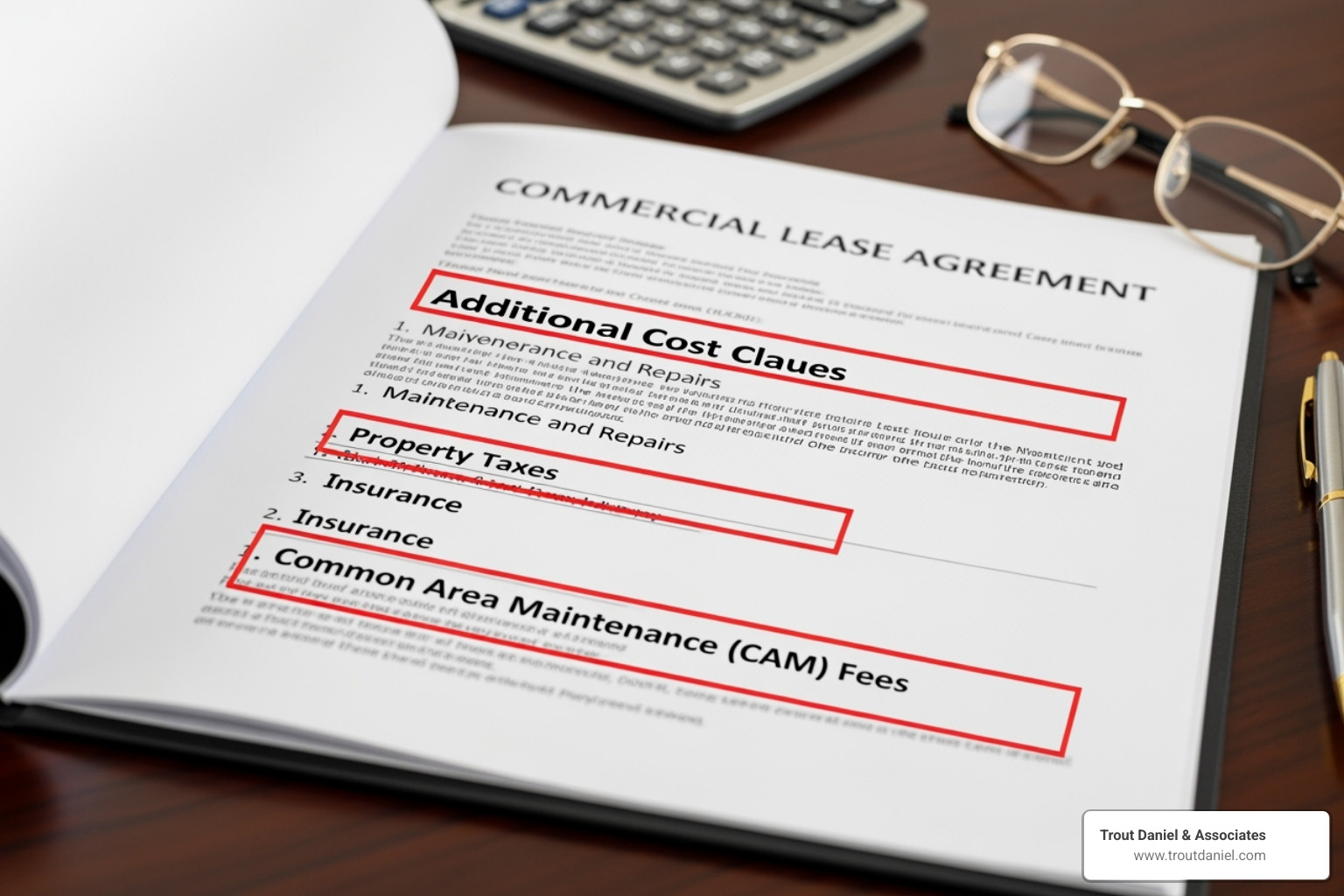
Per the Lease, the Tenant is responsible to pay its proportional share of the Landlord’s passed through Operating Expenses. To elaborate, the proportional amount is determined by taking the Total Square footage of the Tenant’s Premises and dividing it by the Total Square Footage of the Shopping Center. For example, if the Tenant occupies 1,500 sf and the Property is 125,000 sf, the Tenant’s proportional contribution to Operating Expenses is 1,500/125,000 or 0.012 or 1.2%. As discussed above, the Operating Expenses are typically:
- Property Taxes: The Tenant will pay, from the example above 1.2% of the total annual Property Taxes on the Property.
- Property Insurance: The Tenant will pay 1.2% of the Total Property Insurance on the Property. It’s important to remember that this does not include any insurance requirements that the Landlord demands per the Lease for the Tenant’s business Property and Casualty and umbrella insurance.
- Common Area Maintenance (CAM): The Tenant will pay 1.2% of the Annual Shopping Center CAM expenses. These expenses include snow removal, parking lot striping, exterior lighting, etc. amongst other spelled-out costs in the Lease.
The Importance of a Business Plan
We have discussed in detail, the Rent portion of Tenant Expenses. However, there is other overhead that must be considered for the Tenant to make an informed decision when selecting a site. Therefore, it is fundamental that the tenant prepares a formal business plan in order to make sales and expense projections. I strongly encourage my clients to take the time and make the effort to do this. while preparing the Pro-forma Income Statements, as part of the plan, several line items must be considered. In addition to the rent, these include utilities such as gas and electric and water, repairs and maintenance, trash removal, etc.
What Drives Retail Rental Prices?
Understanding the cost to rent retail space means understanding the market forces that shape it. Rental prices are a product of supply and demand, property features, and broader economic trends.

Understanding what Influences Market Rents
Landlords set rents as a result of several factors. These include location, vehicle or pedestrian traffic, tenant demand for space, and desirability (age and appearance) of the Property. However, it is not a “one way street!” Tenants have their own criteria for making rent decisions. These include population and other demographics, visibility of the retail premises, access, etc. It is at this “convergence” of Landlord and Tenant wants and needs where the two Parties begin the rent negotiations. It is important that the Tenant considers several different Properties in which to place its business. the ability to walk away from a deal is a great leverage point in negotiating. Also, it is not reasonable to expect success, if the negotiated rent does not fall within the acceptable parameters of the tenant’s business plan.

The Value of Professional Representation
At Trout Daniel & Associates, we bring deep market knowledge and negotiation expertise to the table. We help you:
- Make Informed Decisions: We know the fair prices, market trends, and promising areas across DC, Maryland, Virginia, and our other service regions.
- Secure Better Terms: We negotiate on your behalf for lower rent, caps on NNN charges, better tenant improvement allowances, and other critical clauses that save you money.
- Avoid Costly Pitfalls: We guide you through due diligence to uncover issues with zoning, building condition, or CAM charges before you sign.
- Save Time and Energy: We handle the property searches, communications, and paperwork, so you can focus on running your business.
To see how we partner with retailers from site selection through lease execution, visit our Retail Services.
As we explain in Why Hire a Real Estate Broker, having an expert in your corner can save you thousands of dollars and countless headaches. Your retail space is one of your biggest business decisions; it deserves professional attention.
Conclusion
The key takeaway is that the cost to rent retail space is a package deal. It includes your base rent plus NNN charges, tenant improvements, utilities, and maintenance. We’ve covered how to decode lease terms, anticipate all expenses, and budget effectively using metrics like the rent-to-income ratio, where retailers should aim for 5-10% of gross revenue.
Doing your homework is crucial, but you don’t have to do it alone. At Trout Daniel & Associates, we’ve spent decades helping businesses across DC, Maryland, Virginia, Pennsylvania, Delaware, and West Virginia find retail spaces that set them up for success. We negotiate on your behalf, spot potential problems, and ensure there are no expensive surprises down the road.
Your retail space should be a launchpad for success, not a source of financial stress. For expert guidance in finding and securing the perfect retail space for your business, contact the team at Trout Daniel & Associates. Explore our retail services and let’s find a space where your business can truly thrive.