


Why Commercial Lease Advice Matters for Your Business Success
Expert commercial lease advice is not a luxury; it’s a fundamental component of your business’s financial strategy. Signing a commercial lease is one of the most significant financial commitments you will ever make, often locking you into a multi-year agreement that dictates a huge portion of your operating budget. For most companies, leases are the second largest expense behind payroll, directly impacting cash flow, profitability, and your ability to scale.
One misstep in a dense, 50-page lease document can have devastating consequences, costing you tens of thousands of dollars over the term of the lease or even forcing your business to close. Consider the hidden costs: we’ve seen tenants who budgeted for a $2,000/month base rent suddenly face a bill for over $3,000 once Common Area Maintenance (CAM) charges were added. These charges, which cover the landlord’s costs for managing and maintaining the property, can include everything from landscaping and snow removal to parking lot repairs and security services. Without a cap or careful negotiation, they can escalate unpredictably.
Here’s what you need to know to protect your business:
Essential Commercial Lease Advice:
- Negotiate Everything: Unlike standardized residential leases, nearly every clause in a commercial lease is on the table.
- Understand Your Lease Type: Know the financial implications of a gross, net, or modified gross lease before you begin negotiations.
- Get Professional Counsel: Always have a commercial real estate advisor and an attorney review the lease before you sign.
- Scrutinize Hidden Costs: Demand clarity and negotiate caps on variable expenses like CAM charges.
- Protect Your Personal Assets: Be extremely cautious with personal guarantee clauses that put your personal wealth at risk.
- Plan Your Exit Strategy: Secure favorable renewal options and understand your rights regarding termination and subletting from day one.
The stakes are incredibly high because the legal landscape for commercial tenants is vastly different from the residential market. Residential leases are governed by extensive consumer protection laws that provide a safety net for tenants. Commercial leases, on the other hand, operate primarily under basic contract law. This means you have virtually no protections beyond what is explicitly written in your lease agreement. The law presumes that businesses are sophisticated parties capable of negotiating on their own behalf. Landlords and their attorneys draft these agreements to protect their own interests, not yours. Without proper guidance, you could inadvertently agree to an inflexible, landlord-favored contract that hinders your business’s growth for years to come.
The good news is that this flexibility can work in your favor. Because commercial leases are so negotiable, you have the opportunity to craft an agreement that aligns with your specific business needs. Nearly every term can be adjusted if you know what to ask for and how to negotiate effectively. While online resources can offer a starting point, such as Nolo’s overview on how to negotiate a commercial lease, they cannot replace the custom guidance of an experienced professional. The key is to conduct thorough due diligence and assemble the right team of advisors.
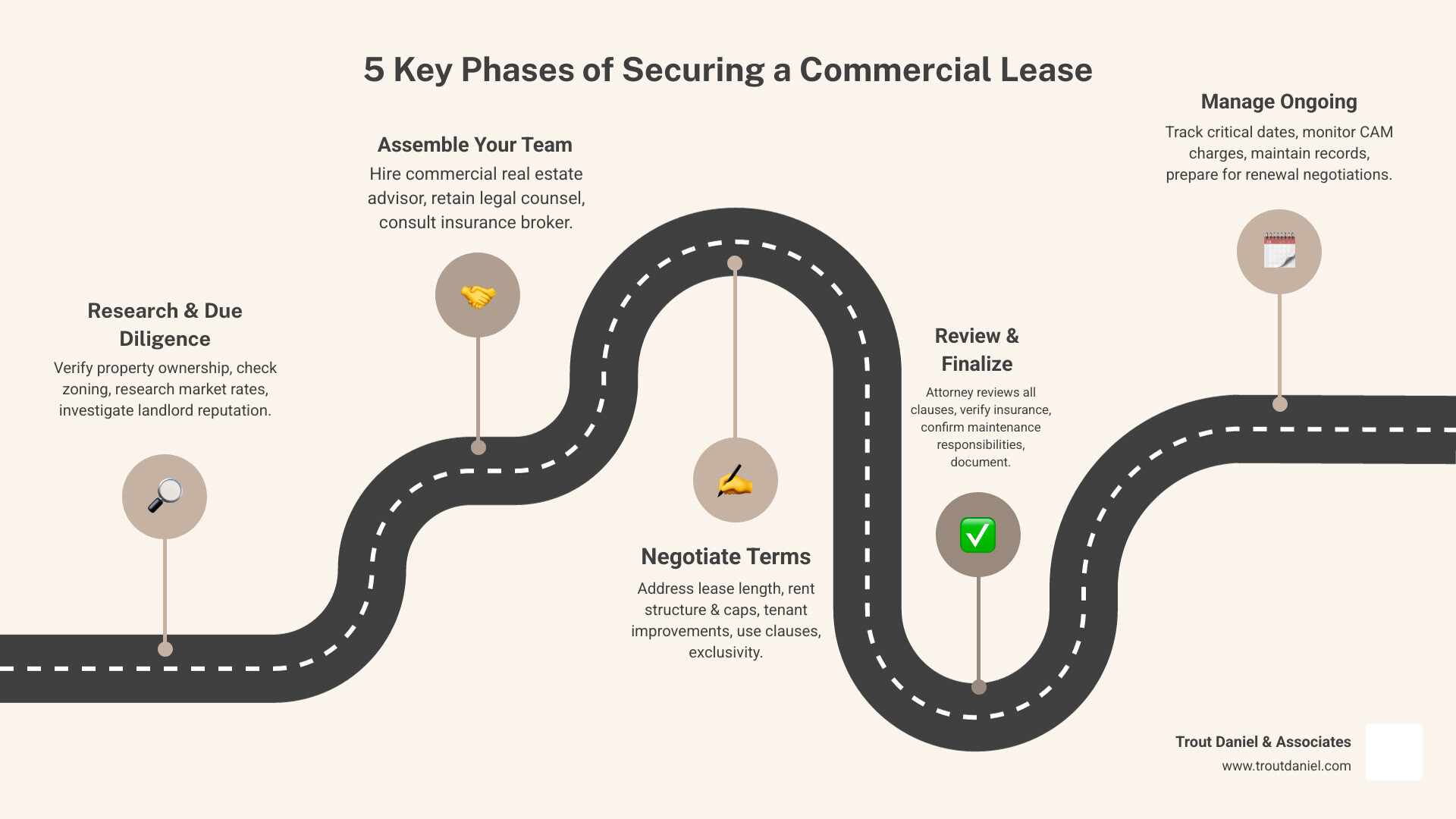
As Arthur Putzel, managing partner at Trout Daniel & Associates with over three decades of experience in commercial real estate, I’ve helped countless businesses steer complex lease negotiations and avoid these costly mistakes. Our team at TD&A specializes in representing tenants, ensuring the final agreement supports your long-term success. Throughout this guide, we’ll share practical commercial lease advice to empower you to secure terms that protect your business and provide a stable foundation for growth.
First Principles: Understanding Commercial Lease Fundamentals
Commercial vs. Residential Leases: Key Distinctions
Let’s start by clearing up a common misconception: a commercial lease is not just a residential lease with a business name on it. It’s a completely different legal and financial instrument. The differences are stark, and understanding them is the first piece of crucial commercial lease advice we can offer.
Here’s a deeper look at why they’re so different:
Fewer Protections for Tenants: Residential leases are heavily regulated by consumer protection laws that dictate things like security deposit handling, eviction procedures, and the landlord’s “warranty of habitability.” In the commercial world, these protections are virtually non-existent. The law assumes a level playing field between two businesses. This means if the HVAC breaks in the middle of summer, the landlord may have no obligation to fix it unless the lease explicitly says so. If it’s not in writing, it doesn’t exist.
Highly Negotiable: While residential leases are often “take-it-or-leave-it” standardized forms, commercial leases are highly customizable. Nearly every term—from the base rent and annual escalations to renewal options, tenant improvement allowances, and even exclusivity clauses that prevent the landlord from renting to a competitor—can be negotiated. This is where your leverage and expert commercial lease advice become your greatest assets.
Longer Terms: Commercial leases typically span three to ten years, and can be even longer for large industrial or anchor retail spaces. This contrasts sharply with the one-year terms common in residential rentals. Landlords prefer longer terms to ensure a stable return on their investment, especially if they are contributing significant funds to customize the space for you (a Tenant Improvement Allowance). For tenants, a long term offers stability but reduces flexibility if your business outgrows the space or needs to pivot.
Greater Tenant Responsibilities: Commercial tenants bear significantly more responsibility for the property. While a residential renter’s obligations usually end with paying rent and keeping the unit clean, a commercial tenant may be responsible for property taxes, building insurance, all maintenance (including major structural repairs), and even ensuring the property complies with the Americans with Disabilities Act (ADA). These responsibilities vary dramatically based on the lease type.
Custom Agreements: There is no “standard” commercial lease. Most are custom-drafted by the landlord’s attorney to be heavily landlord-favorable. This means every word and every clause must be carefully reviewed and negotiated to protect your interests. Relying on a template or a handshake agreement is a recipe for disaster.
Decoding the Jargon: Common Types of Commercial Leases
Understanding the different types of commercial leases is fundamental. The lease structure dictates who pays for the building’s operating expenses, which can dramatically affect your total monthly occupancy cost. Getting good commercial lease advice on this point alone can save you thousands.
Here are the most common types, what they mean, and who they’re best for:
| Lease Type | Description | Who Pays What (Typically) | Best For… |
|---|---|---|---|
| Gross Lease | Tenant pays a single, flat monthly rent. The landlord is responsible for all property operating expenses. | Tenant: Base Rent. Landlord: Property Taxes, Insurance, Maintenance, Utilities. | Tenants who prioritize a predictable, all-inclusive monthly cost. Common in multi-tenant office buildings. |
| Modified Gross Lease | A hybrid model where the tenant pays base rent plus some of the operating expenses, which are negotiated. | Tenant: Base Rent + a portion of some costs (e.g., utilities, janitorial). Landlord: Other costs (e.g., structural repairs, property taxes). | Tenants seeking a balance between the predictability of a gross lease and the lower base rent of a net lease. |
| Single Net (N) Lease | Tenant pays base rent plus their pro-rata share of the property taxes. | Tenant: Base Rent, Property Taxes. Landlord: Insurance, Maintenance. | This type is less common but can be found in some industrial or retail settings. |
| Double Net (NN) Lease | Tenant pays base rent plus their pro-rata share of property taxes and property insurance. | Tenant: Base Rent, Property Taxes, Insurance. Landlord: Structural Maintenance. | Common for multi-tenant industrial and retail properties where landlords want to pass on variable tax and insurance costs. |
| Triple Net (NNN) Lease | Tenant pays base rent plus all operating expenses: property taxes, insurance, and all maintenance costs. | Tenant: Base Rent, Property Taxes, Insurance, All Maintenance. Landlord: Almost nothing beyond the mortgage. | Freestanding commercial buildings and single-tenant retail spaces. This is the most landlord-favorable lease type. |
| Percentage Lease | Tenant pays a base rent plus a percentage of their gross sales above a pre-determined threshold. | Tenant: Base Rent + % of Gross Sales. Other expenses are handled as in a gross or net lease structure. | High-traffic retail locations like malls and shopping centers, as it aligns the landlord’s success with the tenant’s. |
A Triple Net (NNN) Lease is one of the most common but also carries the most risk for tenants. While it often comes with a lower base rent, you are responsible for all costs associated with the property. This includes not just routine maintenance but also major capital expenditures like replacing the roof or the HVAC system. It is critical to negotiate caps on these expenses and demand the right to audit the landlord’s CAM charges annually to ensure you are not being overcharged.
With a Gross or Modified Gross Lease, the simplicity is appealing, but be wary. Landlords will estimate their annual operating costs and bake them into your rent. You should negotiate a “base year” stop, which means you only pay for increases in operating expenses above the amount from your first year, protecting you from paying for pre-existing inefficiencies.
Finally, a Percentage Lease requires careful negotiation around the definition of “gross sales.” You should seek to exclude items like sales tax, returns, and gift card sales to ensure you are only paying a percentage of your actual revenue.