

Why Finding the Right Retail Property Requires a Strategic Approach
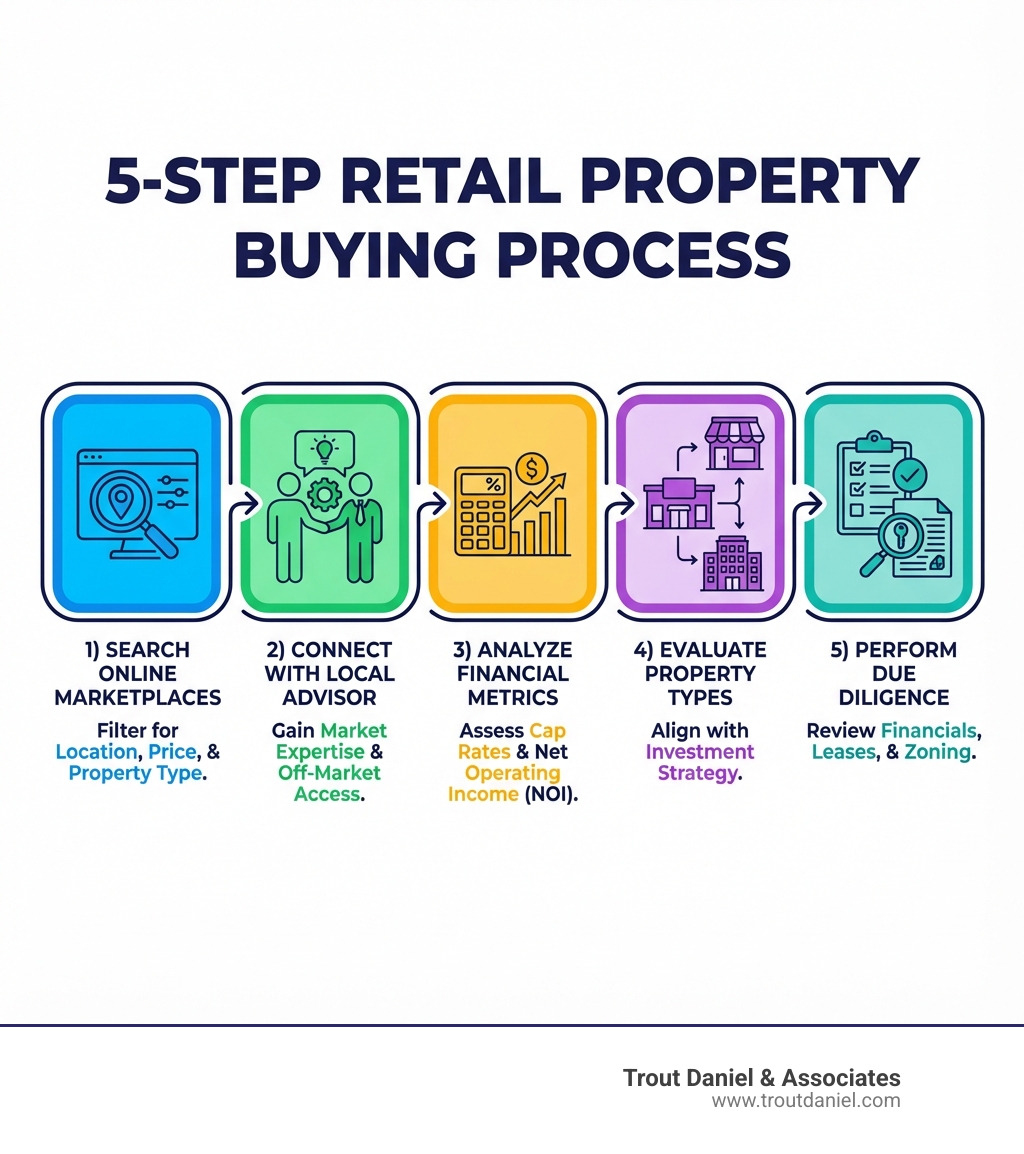
Retail properties for sale offer strong investment potential, but finding the right one requires more than browsing online listings. A strategic approach is essential. Here’s how to locate quality retail properties efficiently:
- Use specialized CRE marketplaces like LoopNet or Crexi.
- Partner with a local commercial real estate advisor for access to off-market deals.
- Analyze key financial metrics like cap rates and price per square foot. Also understand the property’s historical income and expenses and how these factors compare to other similar properties in the market.
- Explore different property types, from strip centers to freestanding buildings.
- Conduct thorough due diligence on financials, leases, and zoning.
The commercial real estate market has evolved. With millions of monthly visitors on platforms like LoopNet, the landscape is more accessible than ever. But accessibility doesn’t mean simplicity.
Finding properties that align with your investment goals means understanding market trends, financial metrics like Net Operating Income (NOI) and cap rates, and property type nuances. Whether you’re targeting a grocery-anchored shopping center or a value-add opportunity, each property has distinct considerations for location, tenant mix, and management.
The retail sector is changing. E-commerce reshapes brick-and-mortar demand, while experiential retail and mixed-use developments create new opportunities. Smart investors evaluate foot traffic, demographic data, and long-term market positioning.
1. Harness the Power of Online CRE Marketplaces
Online commercial real estate (CRE) marketplaces are invaluable for identifying retail properties for sale. Platforms like LoopNet have revolutionized the search process with vast, filterable databases. With hundreds of thousands of active listings, these sites are a powerful starting point for any investor.
These platforms allow us to cast a wide net across target markets like Baltimore, MD, or Fredericksburg, VA. We can specify search parameters to ensure we only see properties that fit our investment thesis.
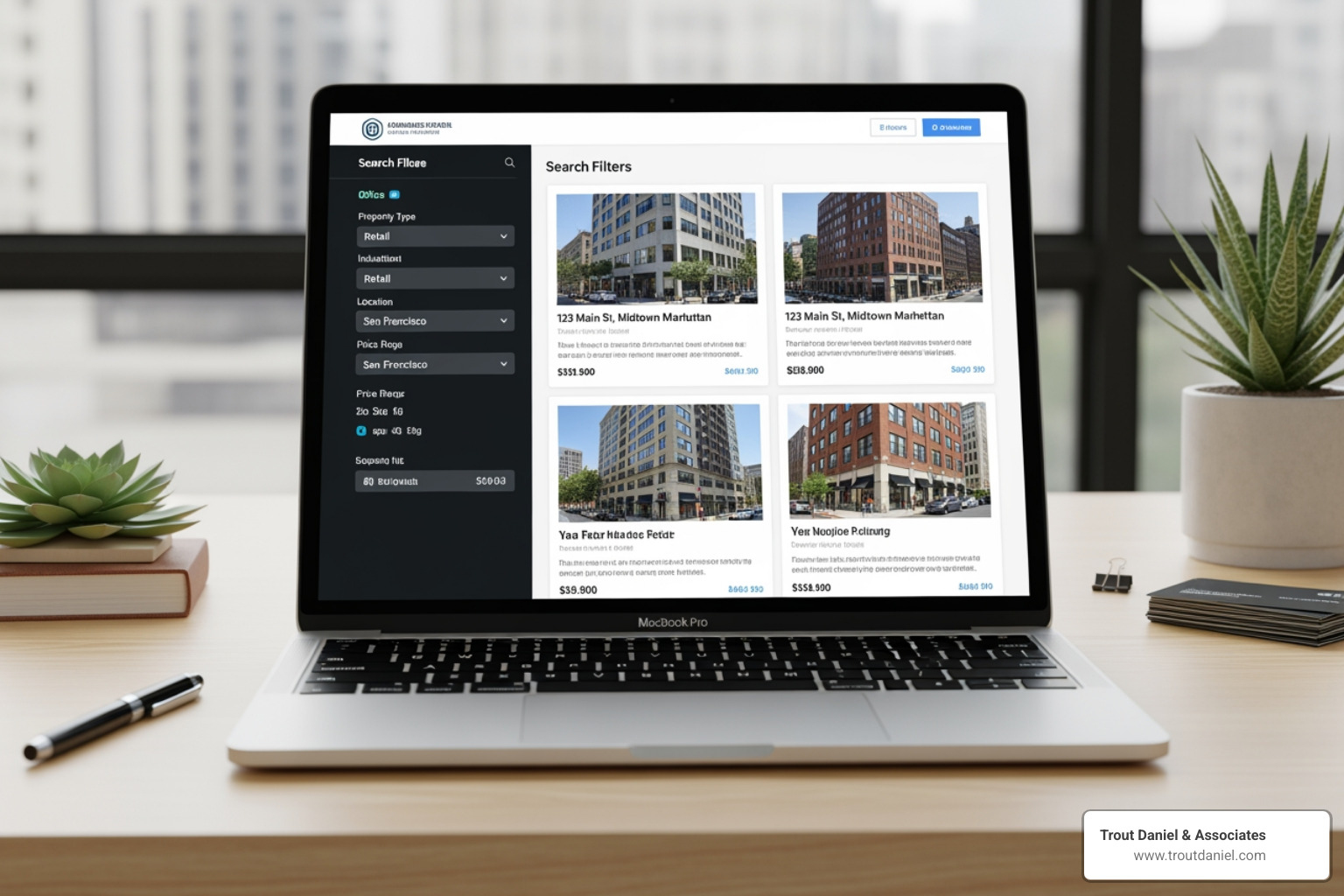
When searching for retail properties for sale, we leverage these platforms to:
- Filter by Property Type: Narrow options to specific categories like shopping centers or freestanding buildings.
- Location-Based Search: Pinpoint cities or neighborhoods in our service areas, such as Lutherville-Timonium or Pikesville, to focus on high-growth corridors.
- Price and Size: Set parameters to manage budget and align property size with operational needs.
- Keyword Search: Use keywords like “grocery-anchored” or “drive-thru” to find specific features.
- Listing Alerts: Save searches to receive notifications about new properties that match our criteria, keeping us ahead of the curve.
- Market Data: Access analytics on local trends, pricing, and cap rates to understand the investment landscape.
How to Effectively Use Online Listings
While online marketplaces provide incredible information, they require a strategic approach focused on intelligent analysis and efficient screening.
- Save and Compare: We save detailed searches to revisit properties, track status changes, and compare them side-by-side.
- Initial Screening: We perform an initial screen of high-level details, photos, and financial summaries to spot red flags and save time.
- Identify Brokers: Listings provide broker contact information. These brokers often have additional insights and may know of off-market retail properties for sale.
- Understand Listing Details: Pay close attention to descriptions, especially regarding lease structures like Triple Net (NNN) leases.
- Use Map Features: Interactive maps help assess a property’s proximity to major roads, residential areas, and complementary businesses, gauging foot traffic and accessibility.
- Filter by Cap Rate: Advanced filters allow sorting by cap rate, a quick way to identify properties meeting a desired return. While average retail cap rates in some markets are 4.48%-7.00%, understanding the local market is key to interpreting these figures.
2. Work with a Trusted Commercial Real Estate Advisor
While online tools are powerful, partnering with a trusted commercial real estate advisor is indispensable for navigating the complexities of acquiring retail properties for sale. At Trout Daniel & Associates, we offer boutique service, one-to-one consultation, and a single point of contact to manage your CRE portfolio and prioritize your success.

Our advisors provide expertise and access that online platforms cannot replicate:
- Exclusive Opportunities: Many of the most attractive retail properties for sale are never publicly listed. Our network in regions like Maryland, Virginia, and Pennsylvania provides access to off-market deals, which can offer better terms and less competition.
- Local Market Expertise: Every market, from Milwaukee, WI, to Melbourne, FL, has unique nuances. We have deep local knowledge of zoning, demographics, and growth patterns, which is crucial for evaluating a property’s potential and avoiding mistakes. We know what kind of retail thrives in Fredericksburg, VA, versus Carmel, IN.
- Negotiation Skills: Our seasoned advisors negotiate tirelessly to secure the best possible terms on price, leases, and other contractual specifics.
- Transaction Management: We manage every aspect of the transaction, from offer to closing, coordinating with all parties to ensure a smooth process.
- Professional Network: We connect clients with trusted professionals, including CRE attorneys, lenders, appraisers, and property managers.
- Due Diligence Support: Our advisors guide clients through the rigorous due diligence process, identifying risks and opportunities.
Why a Local Advisor is Your Greatest Asset
Working with a local advisor is a strategic advantage.
- Proprietary Data: We have access to detailed demographic reports, traffic counts, and sales data not publicly available for regions like Charles Town, WV, or Winston-Salem, NC.
- Market Nuances: We understand the subtle shifts in local economies and consumer behavior that impact the success of retail properties for sale.
- Time and Money Savings: Our expertise streamlines the acquisition process, reducing time spent on unproductive searches and minimizing costly errors.
- Complex Paperwork: We help clients steer the mountain of legal and financial documents involved in CRE transactions.
- Advocacy: We act as your advocate, ensuring your goals are always at the forefront.
- Value-Add Opportunities: We have a keen eye for properties that can significantly increase in value through repositioning, tenant mix optimization, or improvements.
3. Analyze Market Trends and Financial Metrics
Investing in retail properties for sale is a data-driven endeavor. To make informed decisions, we must analyze market trends and financial metrics to understand a property’s true value, potential return, and risks.
Current retail trends show a shift towards experiential retail, mixed-use developments, and convenience-oriented properties. Understanding these trends is crucial when evaluating investments. For instance, a property in a growing area like Fishers, IN, might benefit from demand for lifestyle centers, while a Baltimore, MD, location might thrive with renewed interest in urban storefronts.
Key factors we consider include:
- Cap Rates (Capitalization Rates): This metric estimates potential return, calculated by dividing Net Operating Income (NOI) by the purchase price. While retail cap rates in some markets range from 4.48% to 7.00%, they fluctuate based on location, property type, and tenant quality. A higher cap rate often indicates higher risk.
- Net Operating Income (NOI): This is the annual income after operating expenses but before debt service and taxes. A strong, consistent NOI is a hallmark of a healthy property.
- Cash Flow: We analyze projected cash flow to ensure the property can cover its expenses and provide a return.
- Occupancy and Tenant Quality: High occupancy signals strong demand. The quality of tenants is equally important, as strong national or regional tenants with solid credit reduce vacancy risk.
- Experiential and Mixed-Use: Properties offering experiences (dining, entertainment) or part of mixed-use developments often show greater resilience and growth potential.
Key Metrics to Evaluate
We also dive into other critical metrics for retail properties for sale:
- Debt Service Coverage Ratio (DSCR): Measures a property’s ability to cover debt payments. A DSCR of 1.25 or higher is generally healthy.
- Gross Rent Multiplier (GRM): A quick way to compare a property’s price to its gross annual rental income, useful for initial screening.
- Price per Square Foot: A standardized way to compare the cost of different properties. Knowing the average in a market like Baltimore helps assess if a property is priced competitively.
- Occupancy Classifications: We categorize properties to inform investment strategy:
- Core: 90%+ occupancy; stable, lower-risk.
- Value-Add: 60%-90% occupancy; opportunities to increase value.
- Opportunistic:
- Demographic Data: We analyze population growth, household income, and age distribution to ensure the property’s offerings align with the local community.
- Foot Traffic Analysis: We investigate pedestrian and vehicular traffic counts to assess visibility and accessibility, as high foot traffic often commands higher rents.
4. Explore the Diverse Types of Retail Properties for Sale
The world of retail properties for sale is diverse. Understanding the different categories is crucial for diversifying an investment portfolio, aligning with an investment strategy, and managing risk. Each property type offers distinct advantages, challenges, and suitability for various tenant mixes and locations.
When we evaluate retail properties for sale, we consider how the property type impacts:
- Property Diversification: Spreading investments across different retail types mitigates risk.
- Investment Strategy: Some types are better for stable income, while others offer greater value-add potential.
- Risk vs. Reward: Risk and reward vary significantly between a single-tenant building and a large shopping center.
- Tenant Mix: The property type often dictates the ideal tenant mix, affecting stability.
- Location Suitability: Certain retail types thrive in specific locations, like a busy Baltimore street or a suburban community in Carmel, IN.
Common Retail Property Categories
Let’s break down some of the most common categories of retail properties for sale:
| Property Type | Typical Cost (Relative) | Management Effort (Relative) | Tenant Stability (Relative) |
|---|---|---|---|
| Strip Center | Medium | Medium | Medium |
| Freestanding Building | Medium-High | Low-Medium | High (often single tenant) |
| Shopping Mall | High | High | Medium-High |
- Shopping Centers: A broad category with multiple tenants.
- Community Centers: Anchored by a discount department store or junior anchor.
- Lifestyle Centers: Open-air centers with upscale tenants, dining, and entertainment.
- Neighborhood Centers: Convenience-oriented, anchored by a supermarket or drugstore.
- Outlet Malls: Feature manufacturers’ and retailers’ outlet stores.
- Power Centers: Dominated by several large anchor tenants like big-box retailers.
- Regional Malls: Enclosed malls with one or more department stores as anchors.
- Strip Malls: Rows of stores with a shared parking lot.
- Freestanding Buildings: Single-tenant properties, often a restaurant, bank, or national retail chain, offering strong visibility.
- Storefront Retail: Ground-floor retail units, often in urban or main street districts like downtown Baltimore.
- Mixed-Use Properties: Combine retail with residential or office space, creating built-in foot traffic.
- Restaurant Spaces: Properties designed for food and beverage businesses.
- Pad Sites: Outparcels of a larger development, typically a freestanding tenant like a quick-service restaurant or bank, prized for their visibility.
When considering retail properties for sale, we help clients determine which category best suits their investment goals, whether they seek passive income, value appreciation, or a specific venture.
5. Master the Art of Due Diligence
Purchasing retail properties for sale without thorough due diligence invites unexpected problems. This critical phase is where we mitigate risks, verify claims, and ensure the investment aligns with our client’s financial security. It’s a rigorous process requiring expertise and attention to detail.
Our comprehensive due diligence process covers:
- Risk Mitigation: Identifying potential financial, legal, and physical risks before commitment.
- Property Verification: Confirming all seller-provided information, from square footage to zoning.
- Investment Security: Ensuring the property is a sound investment that meets client objectives.
- Professional Inspections: Engaging qualified inspectors for structural, mechanical, and environmental assessments.
- Legal and Financial Review: Examining all legal documents, leases, permits, and financial statements.
Key Financials to Review for a Retail Property for Sale
The financial health of a retail property for sale is paramount. We review all documentation to understand its performance:
- Lease Agreements: We analyze every lease, noting terms, rates, renewal options, and tenant responsibilities (e.g., Triple Net (NNN) leases). Understanding remaining lease terms is crucial for assessing income stability.
- Rent Roll Analysis: This document lists all tenants, rents, and lease dates. We use it to assess income, potential vacancies, and tenant mix.
- Service Contracts and Operating Expenses: We review contracts and historical expenses (utilities, insurance, CAM) to forecast future costs.
- Property Tax Statements: We examine tax history to project future liabilities.
- Tenant Creditworthiness: We assess the financial strength of major tenants, as strong tenants mean reliable income.
Understanding Zoning and Legal Requirements for a Retail Property for Sale
Legal and regulatory compliance is non-negotiable. We ensure retail properties for sale meet all requirements:
- Zoning and Permitted Use: We verify the property’s zoning allows for current and planned retail uses, which is essential in MD and VA markets.
- Building Codes: We ensure the property adheres to all current building, fire, and safety codes.
- ADA Compliance: We check for compliance with the Americans with Disabilities Act (ADA), as non-compliance can lead to expensive retrofits.
- Environmental Site Assessment: A Phase I assessment identifies any potential environmental contamination, which can have significant legal and financial implications.
- Title Search and Survey: A title search confirms clear ownership and identifies any liens or encumbrances. A survey verifies property boundaries and easements.
By mastering due diligence, we empower clients to invest in retail properties for sale with confidence, minimizing surprises and maximizing success.
Frequently Asked Questions about Retail Real Estate
Clients often ask similar questions when considering retail properties for sale. Here are some common ones, answered with our expert perspective:
What are the most important factors when buying a retail property?
When evaluating retail properties for sale, we emphasize several critical factors for success:
- Location, Visibility, and Access: A prime location is paramount, offering proximity to target demographics, clear sightlines, and easy ingress/egress.
- Foot Traffic: Consistent foot traffic translates directly to sales. We analyze pedestrian counts and nearby attractions.
- Tenant Quality and Mix: For multi-tenant properties, a strong, diverse tenant mix creates synergy and stability.
- Lease Terms: The length, structure (e.g., NNN), and renewal options of existing leases impact income stability.
- Financial Performance: A clear understanding of the property’s Net Operating Income (NOI), cash flow, and cap rate is essential.
- Physical Condition: A thorough inspection is recommended to identify any major structural or systemic problems.
What is a good cap rate for a retail property?
There’s no single “good” cap rate for retail properties for sale; it depends on many factors. Generally, retail cap rates range from 4% for stand-alone NNN retail properties to 8% or higher for un-anchored strip centers.
- Higher Risk, Higher Cap Rate: Properties with higher perceived risk (e.g., a less creditworthy tenant, challenging location) demand a higher cap rate to compensate investors.
- Lower Risk, Lower Cap Rate: Stable properties with long-term leases to national credit tenants in prime locations have lower cap rates, as investors accept a lower yield for security.
A “good” cap rate aligns with your risk tolerance and investment goals, based on a thorough analysis of the property and market.
How is technology changing modern retail spaces?
Technology is reshaping retail properties for sale, creating new opportunities:
- Smart Building Systems: Smart HVAC, lighting, and security systems reduce operational costs and improve tenant comfort.
- Energy Efficiency: Green building technologies attract environmentally conscious tenants and can reduce utility expenses.
- Data Analytics: Sensors and Wi-Fi tracking provide insights into customer behavior and traffic patterns.
- Customer Connectivity: Seamless Wi-Fi is now a standard expectation, enhancing the customer experience.
- Omnichannel Integration: Physical stores are becoming hubs for online order fulfillment, returns, and experiential marketing.
- Improved Security: Modern surveillance and access control systems improve safety and reduce liability.
These advancements influence property design, operations, and the appeal of retail properties for sale.
Conclusion
Finding the right retail properties for sale demands a comprehensive, strategic approach. We’ve explored five key strategies: using online marketplaces, partnering with a CRE advisor, analyzing financial metrics, understanding property types, and mastering due diligence.
Each step is interconnected. While online platforms offer access to data, the nuanced insights and exclusive opportunities from a dedicated advisor are invaluable. Understanding a property’s financials—from cap rates to tenant creditworthiness—empowers sound decisions. Recognizing the characteristics of different retail property types allows for strategic diversification. Finally, rigorous due diligence protects your investment from unforeseen challenges.
At Trout Daniel & Associates, we believe professional guidance is a necessity. Our client-centric service ensures you have a single point of contact and a dedicated team committed to your success in the dynamic world of retail real estate.